Sunday, February 27, 2011

Baseball in Cleveland will never be the same without Bob Feller: Paul Hoynes commentary


CLEVELAND, Ohio -- Hi Corbett Field was nearly empty on a long ago spring morning.

Bob Feller was the only occupant on the Indians' spring training grounds. He was in right field, in full uniform, going through his pitching delivery. He'd come to a set position, whirl and throw the ball into the right field wall.

Feller was practicing his pickoff move to second. Why not? He was only in his 70s.

Bob Feller, the greatest Indian of them all, is gone. He died Wednesday night and baseball in Cleveland will never be the same.

The birth of the new season didn't mean a thing until Feller walked into the spring-training press room, cracking jokes and passing out a new set of his autographed baseball cards to anyone within arm's reach. It didn't matter if it was Tucson, Ariz., Winter Haven, Fla., or Goodyear, Ariz., the sun couldn't shine and Indians players couldn't start pulling their hamstrings until No.19 reported.

He was sharp of mind, a red state unto himself and had an opinion on everything. He moved easily among the rich and famous. He danced with Marilyn Monroe, pitched to Joe DiMaggio and Ted Williams, mingled with admirals and generals. Everyone knew Rapid Robert, the Heater from Van Meter.

In Winter Haven one morning, reporters were talking about what Indians players might open the season on the disabled list. The war in Iraq was raging on and Feller quickly tied the two together.

"I was just in Washington, D.C., talking to some generals," Feller said. "I'll tell you who's going on the disabled list ... Saddam Hussein."
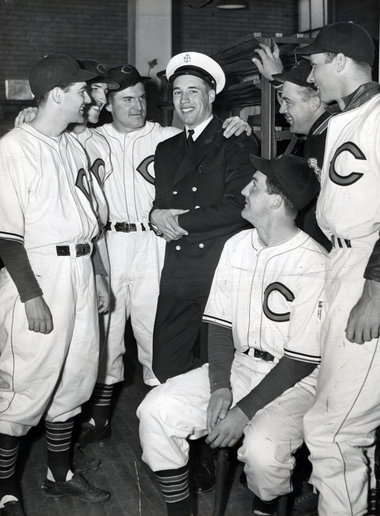
Feller won 266 games with the Indians, throwing three no-hitters and 12 one-hitters. At his peak, he joined the U.S. Navy right after Pearl Harbor in 1941 and lost nearly 3 1/2 years of his career in World War II.

Feller told me it probably cost him about 60 victories, but he had no regrets about going to war.

"We were getting the hell kicked out of us," he said. "I thought we needed some help."

My favorite memory of Feller was listening to him talk about the barnstorming tour he organized with Satchel Paige and other Negro League stars. It was a blue-sky day at Chain of Lakes Park in Winter Haven as Feller talked to a group or reporters, but he made it sound as if the tour between big-league stars and Negro League greats happened yesterday.

Feller organized the tour, booked the hotels and travel. I don't know if he sold tickets, but he may have. He and Paige pitched two to three innings every day of the tour. He remembered dates, towns and crowd sizes.

He ranked Paige as one of the top 20 pitchers of all time. He gave scouting reports on other Negro League players, turning the mist of legend into muscle and flesh. It was an oral history of baseball and I'm still kicking myself for not taping it.

In last season's World Series between San Francisco and Texas, the Giants had Hall of Famers Juan Marichal, Willie McCovey, Orlando Cepeda and Gaylord Perry throw out the first pitch from Game 1. Willie Mays would have been there, but he wasn't feeling well.
In Cleveland, the Indians only had Feller at that pristine level of baseball greatness. The good thing was he was he never left.

• Playing catch in front of the Indians' dugout with Omar Vizquel in Winter Haven just before game time as the PA announcer reeled off his statistics that the crowd knew by heart.

• Sitting in the press box for the opening of Jacobs Field in 1994 as Seattle's Randy Johnson threatened, but eventually failed to match his record for throwing the only opening day no-hitter in history.

• Telling you his itinerary for his next round of card shows, "I'm in Dubuque on Tuesday, Nashville on Friday, Chicago on Sunday. Then I'm going to Iowa and we're going to walk out of a corn field just like in the movie."

He made his living by being Bob Feller. Herb Score used to call him "Inc." He was Bob Feller, Incorporated.

Several years ago he was asked how much he would be worth at free agent prices. He said without hesitation $15 million to $17 million a year. It was clear he'd thought about it. Today he'd be short-changing himself.

I wonder what Feller would have done if he pitched in the free-agent era? Would he have played his whole career in Cleveland? His talent certainly made him a one-team player such as Cal Ripken Jr. or Tony Gwynn. Or would he have left for more money and better opportunities like so many others?

Such thoughts are not for the moment. Today is for being grateful that we had Bob Feller among us for so long. That he was always there and in no hurry to leave.

Most underrated RH starter: Bob Feller


Editor's Note: The following is an excerpt from "The Stark Truth: The Most Overrated and Underrated Players in Baseball History" by Jayson Stark. Copyright (c) 2007 by the author. This excerpt has been printed with the permission of Triumph Books. For information on how to purchase the book, click here.

I'm still convinced that Bob Feller is the most underrated righthander who ever lived. But only because he is.


Imagine this kid, at 17 years old, pitching an exhibition game in 1936 against a Cardinals team still rolling out most of the lineup that had won the World Series in 1934 -- and striking out EIGHT of the nine hitters he faced. Imagine this kid, a few weeks later, making the first start of his big-league career, and whiffing 15 St. Louis Browns. Imagine him, three weeks after that, ripping off 17 K's against the Athletics -- the biggest strikeout game in American League history at the time. Now imagine him, just a couple of weeks later, heading back home to Iowa -- so he could ride the SCHOOL BUS with his sister and finish high school. All true. It all happened. In real life. He was the LeBron James of his era -- except with a 12-to-6 curve instead of a learning curve.

How many American teenagers have had the impact on their country that Bob Feller once did? His high school graduation was broadcast live -- to the whole U.S.A. (on NBC radio). His face was on the COVER of Time Magazine before he'd even started 10 big-league games. So it's pretty clear Bob Feller wasn't overrated back then.


But that was then. This is now, all these decades later. And Feller no longer gets his due. When ESPN asked its in-house stable of baseball "experts" (full disclosure: myself included) to rank baseball's greatest living pitchers in May of 2006, Feller finished sixth. But in an accompanying ESPN Sports Nation poll of ESPN.com surfers, Feller didn't even make the top 10. (The only other Sports Nation omission from the experts' top 10: Juan Marichal.) Seven years earlier, in the fan voting for the All-Century team, Feller wasn't even close, finishing 13th (with nearly 740,000 fewer votes than Ryan).

So what's up with that?

We'd better remind you -- assuming you ever knew -- just how enormous a figure Feller was in his time. Over the first 95 seasons in the existence of Major League Baseball, only one pitcher cranked out four straight seasons of 240 strikeouts or more -- Bob Feller. In that same period, he and Walter Johnson were the only pitchers who ever led their league in strikeouts 10 or more seasons apart. Through the first nine seasons of Feller's career, he was the most unhittable pitcher in history (allowing just 7.01 hits per 9 innings). And the real proof was all those games in which nobody -- or just about nobody -- got a hit. This man threw three no-hitters and TWELVE one-hitters. Until Nolan Ryan came along, the only pitcher in the 20th century with even half as many combined no-hitters and one-hitters was Walter Johnson (one no-hitter, seven one-hitters). And Feller was the only 20th-century pitcher with three no-hitters until Sandy Koufax showed up.


Feller also just might be (ahem) The Hardest Thrower Who Ever Lived. We'll never know for sure, of course. In his day, there were no radar guns attached to every scoreboard in America -- possibly because radar had only been invented about 20 minutes earlier. But there's one expert who KNOWS (totally for sure) that Feller was The Hardest Thrower Who Ever Lived. And that would be the ever-modest Feller himself.

I'll never forget, back in the 1997 Indians-Marlins World Series, the radar board in Florida threw a "102 mph" up there after one fateful fastball by Marlins closer Robb Nen. Yep, 102. Never saw one of THOSE before. Before the game the next day, the New York Post's Tom Keegan and I spotted Feller on the field. So we decided to ask for ourselves whether he thought he'd ever thrown a pitch that traveled 102 miles an hour. "Hell," he said, "that was my CHANGE-UP."


Feller then proceeded to tell a story about some gizmo, or military invention, called the Electric Cell Device. This was some kind of chamber -- no longer available at a Wal Mart near you -- that was used back in 1946 to clock his fastball. Feller claimed he whooshed a pitch through the old ECD that was measured at 107.9 miles per hour. Must have been that point-9 that made him so hard to hit.


Virtually from the minute he threw his first pitch, there was so much national fascination with Feller and his heater that folks were constantly looking for ways to figure out whether his 100-mph flameball was reality or myth. So in 1940, Feller was lined up for his most legendary pitcher's duel -- with a speeding motorcycle. Just as the motorcycle varoomed by him at 86 mph, Feller launched his fastball at a target 60 feet, 6 inches away. The baseball won that race so easily, it was calculated that his Harley-ball was traveling at 104 mph. Oh by the way, a small hole had been cut out of the target so a camera could record this fabled pitch -- and Feller launched his fastball right through the target, wiping out the camera. So don't try to buy that historic photo on eBay any time soon.

Now no doubt you Nolan Ryan fans out there are saying: "What's the big whoop?" There are all kinds of stories about Ryan -- who was elected (by me) as the most overrated righthanded starter of all time in this book -- that sound just like these, right? Well, there is one significant difference between Ryan and Feller: Feller consistently found ways to convert his smokeball and all his whiffs into wins.


Feller had seven seasons of at least 15 wins and a .

Feller got through war, then got hurt

At the conclusion of the 1941 season, Bob Feller was 22 years old and he'd won 107 games in the major leagues. At that pace ... well, if Feller had continued pitching that well until he was 42, he would have challenged Cy Young's more impressive records.

A war got in the way.

The way Feller told the story, on the 7th of December he was driving his new Buick from his home in Iowa to Chicago, for a meeting with Cy Slapnicka, Cleveland's general manager, and manager Roger Peckinpaugh. Feller expected to sign a new contract for 1942.

Car radios were still uncommon in 1941, and expensive. But when you win 107 games before your 23rd birthday, you can afford the radio and a tinny-sounding speaker. Crossing the Mississippi River into Illinois, Feller heard the bulletin: Japan had attacked Pearl Harbor.

"I knew that the purpose of our meeting had just changed," Feller would write, nearly 50 years later. He would tell Slapnicka and Peckinpaugh that instead of signing a new contract, he would be signing enlistment papers for the U.S. Navy. Immediately.

He could have waited to be drafted, and almost certainly would have been able to continue playing baseball through 1942, at least; with his father terminally ill, Feller was his family's sole financial support. Some players weren't drafted until after the 1943 season. But Feller went right in, voluntarily. A few months into his enlistment, tired of a cushy stateside posting, he pressed for combat duty and spent much of 1943 and '44 commanding a gunnery crew on a battleship, the U.S.S. Alabama.

By the time Feller returned to baseball in 1945, he'd missed more than three-and-a-half seasons. Among the first stars to come back, Feller would be a sort of guinea pig, as nobody knew what such a long layoff would mean for professional baseball players (many of whom would miss two or three full seasons).

In the event, most (though not all) of them picked up right where they'd left off.*

* Most of the stars, anyway. Many dozens of lesser players lost their prime seasons because of the war -- not to mention all the younger men who lost their lives or their health -- and never played in the majors, or even professional baseball, at all.

Of course, eventually another question would come up. From Feller's 1990 autobiography, "Now Pitching: Bob Feller":
Then people began to wonder how we would have done if the war hadn't come along. Baseball fans filled many an hour in those days with that "what-if" question. Eventually, an analyst in Seattle, Ralph Winnie, sat down at his computer and figured out the answers.

He took our individual stats for the last three years before our military services and our first three years after the war, then averaged them out on a per-season basis and projected them across the war years...

In my case, Winnie projected that I would have 107 more games, finishing with 373 career wins instead of 266, with another 1,070 strikeouts, five no-hitters instead of three and 19 one-hitters instead of 12. He calculated that I would have finished with the sixth most wins in history instead of 28th and the seventh most shutouts instead of 29th.

In his book, Feller tempered those numbers a bit, writing, "It may not prove anything ... We could have been injured and missed a full season or slipped on a banana peel, who knows?"

In the years after Feller's book was published, he became more outspoken in his political views -- somewhat famously in these parts, during an ESPN.com chat he went off on "Hanoi Jane" Fonda -- and more willing to take credit for the statistics that might have been his, absent the war.

Realistically, I think such exercises are more instructive for hitters than pitchers, simply because hitters don't run the same injury risk that pitchers do. Feller might have been injured if he'd kept on pitching during the war years. From his Age 19 through Age 22 seasons, Feller averaged 309 innings per season ... though whether that means he was primed for an injury or was invulnerable to fatigue, I really can't hazard a guess.

Upon Feller's discharge from the Navy in August 1945, he returned to the Indians and pitched well in nine late-season starts. In 1946, he enjoyed one of his best seasons, leading the American League in wins (26), games pitched (48), games started (42), complete games (36), shutouts (10), innings (371) and strikeouts (348).

Feller got off to a fine start in 1947, but hurt his knee in June and was never really the same. From that point through the end of his career, nine mostly humdrum years later, he struck out just slightly more than four batters per nine innings.

People wonder how Bob Feller would have done if the war hadn't come along. I wonder how Bob Feller would have done if he hadn't lost his All-World fastball before he turned 29 - Rob Neyer

In his 92 years, Feller saw it all

In his 92 years, Feller saw it all
December, 15, 2010 Dec 1511:30PM ETEmail Print Comments8 By Rob Neyer

I'm sorry to hear about Bob Feller's passing, if not surprised. Most of us have been around long enough what it means when a 92-year-old man is transferred to hospice care. At that point, one can only hope for a peaceful end and perhaps a few more good moments with loved ones.

Bob Feller actually lasted a bit longer than some thought. Almost a week ago, the Northern Ohio Journal actually reported Feller's death, and columnist Jim Ingraham wrote a lovely tribute. That was yanked from the Journal's website a few hours later, but I think this passage is a fine introduction:

Bob Feller won his first 100 games before the age of 23. He died Wednesday at the age of 92.At either end of his life he mocked convention. He made his major league debut -- this is beyond outrageous -- at 17. In his first major league start he set a major league record for strikeouts in a game, and then after that season went back to high school for his senior year. Think about that.

He lived to be 92. How many 92-year-olds do you know?

The year he was born, Alexander Graham Bell was still alive. So were Wyatt Earp and Orville Wright.

When Feller debuted in Van Meter, Iowa, Christy Mathewson was still alive. So were Honus Wagner, Napoleon Lajoie, and Cy Young.

Ty Cobb? Not only was he still alive, he was STILL PLAYING!

As a 17-year-old rookie with the Indians in 1936, Feller needed a place to live. Cy Slapnicka, the scout who signed him, found a room for him in a boarding house in Cleveland. One of Feller’s fellow-boarders in the house had fought in the war -- the Civil War.

As amazing all of those things are, the one thing that always sticks in my head is this: Bob Feller pitched against Lou Gehrig. All the other big stars in the American League in the late 1930s, too. Joe DiMaggio. Jimmie Foxx. Hank Greenberg. Ted Williams.

Of course they're all gone, now. Nearly all of them, anyhow. Hall of Famer Bobby Doerr was actually born a few months before Feller, and debuted in the majors roughly a year after Feller. Hall of Famer Monte Irvin was born just a few months after Feller, though thanks to baseball's segregation he wouldn't reach the (previously all-white) major leagues until he was 30.

Even with Feller's passing, they're still around. It just gets a little harder to find them, all the time.

Almost to the end, though, it was rarely hard to find Bob Feller. Just a few years ago, I saw him give a rousing talk at the SABR Convention in Cleveland. Last summer he was still regularly showing up at the ballpark, one of the few men on earth who had seen Babe Ruth hit, and pitched to Lou Gehrig. And he was still crusty, unimpressed by young players who haven't won a lot of games or enlisted in the Navy during a war or been elected to the Hall of Fame.

Too crusty, maybe, by just a little. Upon seeing Stephen Strasburg in the flesh, Feller said, "Call me when he wins his first 100."

Granted, I've probably said something similar a few times. But when Bob Feller said it, people actually paid attention. He wasn't nasty (well, not often). He was opinionated, and the older he got the more willing he was to express his opinions.

Of course, he won his first 100 games before he turned 23, and did enlist to fight in a war, and was elected to the Hall of Fame. If anyone ever earned the right to the occasional bout of crustiness, it was probably Rapid Robert Feller

http://espn.go.com/blog/sweetspot/post/_/id/6557/in-his-92-years-feller-saw-it-all

Saturday, December 11, 2010

I-View with Bob Feller

While Hall of Famer Cleveland Indians pitcher Bob Feller is receiving hospice care, we wanted to reflect on an outstanding interview he did with The Plain Dealer's Dennis Manoloff in the spring.

Days before Feller took off for spring training, he took the time to share with Manoloff. Just a few of the questions and answers:


PD: When you hear the term 'living legend' used to describe you, what does it mean?

BF: I owe baseball everything I am today. Whatever I may or may not be, I owe to baseball. I think of a young kid who had great parents, teachers, coaches and a scout, Cy Slapnicka, who signed me and took me in almost as his son. Living legend? It's a term I respect and appreciate because I started out as a kid with no idea what might happen in the game. Thanks to Cy having a lot of confidence in me, I was able to pitch for Cleveland.
PD: Which of the nicknames most attached to you do you prefer: The Heater from Van Meter, Bullet Bob or Rapid Robert?

BF: I don't like any of them that much, to be honest. To me, Bullet Bob is Bullet Bob Turley (1958 Cy Young winner). Rapid Robert is the most popular, but I don't care for it. Anne, my wife, doesn't like it, either. I prefer to be called Bob. If they call me Rapid Robert, well, so be it.
PD: In official baseball records and on your statue outside Progressive Field, you are listed as Robert William Andrew Feller. What is behind the two middle names?

BF: My father's name was William. My grandfather -- his father -- was Andrew. Andrew's widow, when I was born in 1918, wanted me to have her husband's name. She asked right in our home in Iowa. So my parents said, "Yes, we're going to name him Robert William Andrew Feller." They didn't. She never knew it when she went to her grave. My legal name at the county recorder's office in Dallas County, Iowa, is Robert William Feller. Robert William Andrew Feller is not my name, legally.
PD: But you don't mind the two middle names?

BF: I don't mind at all.

Saturday, December 4, 2010

Ron Santo

Chicago -- Ron Santo, one of the greatest players in Chicago Cubs history and a longtime WGN radio announcer whose devotion to the perennial losers was made obvious night after night by his excited shouts or dejected laments, has died. He was 70.

"Ronnie will forever be the heart and soul of Cubs fans," Cubs Chairman Tom Ricketts said in a statement Friday. He praised Santo for "his passion, his loyalty, high great personal courage and his tremendous sense of humor."

Santo died in an Arizona hospital from complications of bladder cancer, according to WGN Radio. Santo was diagnosed with diabetes when he was 18 and later lost both legs to the disease.

A nine-time all-star in his 15-year career, Santo was widely regarded as one of the best players never to gain induction into the Hall of Fame. The quiet sadness with which he met the news year after year that he hadn't been inducted helped cement his relationship with the fans.

But nothing brought fans closer to Santo -- or caused critics to roll their eyes more -- than his work in the radio booth, where he made it clear that nobody rooted harder for the Cubs and nobody took it harder when they lost. Santo's groans of "Oh, nooo!" and "It's bad" when something bad happened to the Cubs, sometimes just minutes after he shouting, "YES! YES!" or "ALL RIGHT!" became part of team lore as the "Cubbies" came up short year after year.

"The emotion for me is strictly the love I have for this team," Santo told The Associated Press in August 2009. "I want them to win so bad."

Santo played for the Cubs from 1960-73 and wrapped up his career with the White Sox in 1974. He joined the Cubs' radio team in 1990.

Santo battled myriad medical problems after he retired as a player, having undergone surgery on his eyes, heart and bladder after doctors discovered cancer. On his legs alone, he underwent surgery more than a dozen times before they were ultimately amputated below the knees -- the right one in 2001 and the left a year later.

Don Kessinger, who played shortstop with the Cubs from 1964-1975 and perhaps saw more of Santo's play at third base than anyone else, said what he remembers most is how hard his teammate played every single day.

Kessinger said Santo deserved to be in the Hall of Fame, and cannot understand why he was never elected.

"It's hard for me to believe he wasn't elected, and I'm surprised the veterans committee didn't see fit to put him in," said Kessinger. "It would have meant so much to Ron Santo to be elected into that awesome hall."

Born Ronald Edward Santo in Seattle on Feb. 25, 1940, Santo was diagnosed with juvenile diabetes when he was 18. But he kept it from the team until he made his first All-Star game in 1963, and fans didn't know about his diabetes for years after that.

Even though the Cubs failed to make the World Series in his lifetime, Santo once said his association with the team probably prolonged his life.

"If I hadn't had this when my troubles started, I don't know if I would have survived," he said in September 2003. "I really mean that. It's therapy."

Santo was a fan favorite on a team that included Hall of Famers Ernie Banks, Billy Williams and Ferguson Jenkins. Many taverns near Wrigley Field include photos of Santo, including one in which he famously clicked his heels as he ran off the field.

By all accounts, it was a tremendous career. In his 14 years with the Cubs and his final season across town with the White Sox, the third baseman hit .277 with, 2,254 hits, 342 home runs and 1,331 runs batted in. He also was named to the All-Star team nine times won the Gold Glove award five times.

He hit .300 or better four times, had the best on-base percentage in the league in 1964 and 1966 and led the league in walks four times.

But the team routinely finished at or near the bottom of the standings.

One of the few times the Cubs didn't was in 1969, when they finished second after leading the New York Mets by nine games as late as Aug. 16. That year, a photograph was taken of Santo that became synonymous with both the team's failure and the supposed curses that have long haunted the team: There, in the on-deck circle at Shea Stadium, is Santo, a bat on his shoulder as a black cat scurries past.

Santo's disappointment with being passed over for induction into the Hall of Fame was well known to viewers, who watched him receive the news on the phone in 2003 thanks to television cameras he allowed inside his house when he thought he would be getting in.

In 2003, he was honored by the Cubs, who retired his No. 10, hoisting it up the left-field foul pole, just below Banks' No. 14.

"This flag hanging down the left-field line means more to me than the Hall of Fame," Santo told the cheering crowd at Wrigley Field when his number was retired.

"This couldn't be any better," he said. "With the adversity that I have been through if it wasn't for all of you, I wouldn't be standing here right now."

Santo had been active in fundraising for diabetes research, with his Walk-for-the-Cure raising millions of dollars

Saturday, November 6, 2010

Sparky Anderson - Tim Kurkijan

David Wells was throwing a simulated game at Tiger Stadium on a hot day in 1994, but it could have been any day in any year. Tigers manager Sparky Anderson sat in the dugout, legs crossed, smoking a pipe and watching Wells throw as he talked breathlessly to a writer. He was watching Wells with one eye; with the other, he looked at the writer, with complete attention to both. "He's throwing great,'' he said. "Great curveball. Oh, he's ready.''

That was Sparky Anderson. He was a great judge of talent, and a great communicator with people, all at the same time, all the time, every day of his life.No manager in baseball history was more true to his nickname than George "Sparky'' Anderson. No manager ever loved the game more than Sparky. No manager did the job with the same relentless energy and enthusiasm as Sparky. No manager smiled as often as Sparky. No manager was more of a gentleman than Sparky. No manager was nicer than Sparky. Late in his career, Anderson asked the media to start calling him by his given name, George, saying no man in his 50s should be called Sparky. But, it never took. He was and always will be Sparky.

Part of his charm was his penchant for hyperbole. He once called Kirk Gibson, "the next Mickey Mantle,'' and said second baseman Chris Pittaro was a "future Hall of Famer'' even though everyone knew he wasn't. A writer once asked him about the great Reds teams that he managed, and Sparky ran his hand through his silver hair, put his two hands out and began counting fingers: "Bench, greatest catcher ever. Rose, most hits ever. Morgan, maybe the greatest second baseman ever. Perez, Hall of Famer. Concepcion, should be a Hall of Famer; Foster, unbelievable power; Geronimo, best defensive center fielder in the game,'' then proceeded to name every player on those teams, with a superlative attached to each.

"What do you think?'' he said. "Give me a team that could beat those teams.''

Anderson fractured the English language, but in an engaging, homespun sort of way. Of his Stengelesque mangling of words, which was comical and harmless, Anderson once said, "Why do you have to know English? It's like 'two.' There are three twos! There's tee-oh. There's tee-doublya-oh, and there's tee-double-oh. Three twos! Now, if I put any one of them down in a letter I wrote, you would know which one it is I am talking about. It's like 'there' and 'their.' What is the difference as long as you know there's a there there?''

When Steve Rushin of Sports Illustrated went to do a story on Sparky, Anderson brought up the hilarious movie, "The Naked Gun," and in full uniform in his office, did his impersonation of Leslie Nielsen as the umpire, complete with the moonwalk and the yelling of Steeeeee-rike threeeee.

Anderson was a simple man who was, at times, embarrassed by the money and the lifestyle of a major leaguer, in part because he grew up in South Dakota in a house that didn't have an indoor toilet.

He once said, "I only had a high school education and, believe me, I had to cheat to get that.''

As the manager of the Tigers, he once said on game days, he would mostly stay in his hotel watching TV. "I loved 'Headline News,'" he said. "I could watch it all day. Sometimes, it was the same show, and I'd watch over and over.'' But his simple approach is what made him such a great manager. He didn't try to out-think the room, as some managers do. He knew, and said many times, that managers win only because of the players. At his Hall of Fame induction speech, he made that very clear.

And Anderson was a great manager. He won 2,194 games, sixth most ever. He won five pennants and three World Series. He and Tony La Russa are the only managers to win the World Series in each league. He is the all-time winningest manager for two franchises, the Reds and Tigers. He was inducted in the Hall of Fame in 2000, and nothing made him happier than going back to Cooperstown each year and shaking hands with the other Hall of Famers.

But, as a manager, he was tough when he needed to be. His other nickname was "Captain Hook" because of his willingness to go to his bullpen as often as he saw fit. Some of his pitchers weren't particularly happy about coming out of a game, but Anderson once said of removing a pitcher, "I'll tell you when you're tired.''

Anderson was 36 years old when he took over the Reds in 1970. That was a good team, a relatively young team, but the veterans tested their new manager immediately, and immediately Sparky made it clear: It didn't matter that he was a rookie manager, or only 36 years old, he was in charge, and the players would do as he said. Quickly, they did. The Reds won world championships in 1975 and 1976. Those teams are considered among the greatest teams in National League history.

In 1979, Anderson took over the Tigers. He was instrumental -- but took no credit -- for helping make Gibson, Alan Trammell, Lou Whitaker, Jack Morris and many others the players they became. In 1984, the Tigers started out 35-5, went wire-to-wire to take the division and won the World Series in five games over the Padres. Anderson wrote a diary of that special season, in which he typically lauded in the players in a book titled "Bless You Boys.''

No Sparky, bless you.

Tim Kurkjian is a senior writer for ESPN The Magazine. His book "Is This a Great Game, or What?" was published by St. Martin's Press and became available in paperback in May 2008. Click here to order a copy.